| Home |
 |
|
|
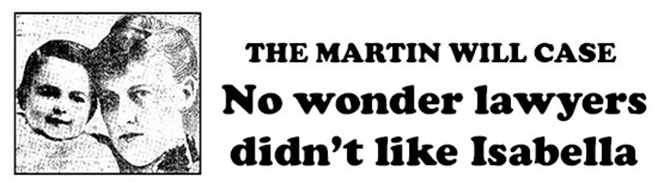
Isabella J. Martin, who 14 years later would be considered the most dangerous woman in the country, was merely an unusually annoying person when she contested her brother-in-law's will in 1894. She insulted opposing lawyers, disrespected the judge and battled her own attorneys. Two of them quit before the trial began and a third was so upset he spoke out during the trial. Fortunately, his remarks were made before the jury was summoned and spectators admitted to the courtroom. What pushed attorney Crittenden Thornton over the edge was what Mrs. Martin said during an ill-advised interview with a reporter from the San Francisco Call. Mrs. Martin wanted to testify during the will case, but her team of lawyers disagreed. Mrs. Martin was determined to air her side of the story, especially after a questionable letter was introduced as evidence against her in court. Contacting the newspaper was a sly move on her part. If taken at face value, the letter, supposedly written by her brother-in-law, Henry Martin, would support her contention that Henry Martin so fond of the young boy Mrs. Martin claimed was his nephew that he wanted to leave him one-third of his estate. However, Henry Martin's widow, May, and her lawyers contended the letter had been forged by Isabella Martin, and also that Henry Martin loathed Isabella and had no use for the boy known as "Baby John." Isabella Martin apparently thought she could swing people to her side through reverse psychology, claiming that because the letter was genuine, that was precisely why she didn't want it used in the trial. She wanted folks to believe she wanted to protect Henry Martin's reputation — and also the reputation of "Baby John." But that's exactly why she forged the letter in the first place — to star people thinking, hey, maybe the second will is genuine because Henry Martin wanted to leave something to his bastard child. In making her case to the reporter, Mrs. Martin delivered a dramatic performance that may have been over-the-top. It was easy to believe the lady doth protest too much. Worse, she was so revved up, she made unflattering and insulting remarks about her lawyers. According to the story: |
|
|
|
She claimed she begged her lawyers not to introduce the letter into evidence. "I knew people would think I was trying to barter my little boy’s good name for a share of Henry Martin’s estate," she said. But that was exactly what she was doing, despite her next remark: "The next two nights I cried until my pillow was wet with tears," she added, probably causing the reporter to stifle the laugh that comment deserved. She told the reporter that Henry was in love with her from the time they met in 1887. He was an over-the-hill bachelor at the time, and it's quite possible that statement was true. But she also said Henry made a move on her after she'd married his brother, and that he often kissed her — "in a brotherly way" — even after he finally married May Blunt Moore in 1890. This seemed unlikely because Henry never came across as the type to risk upsetting his wife, who so disliked her sister-in-law that she avoided situations in which they'd be in the same room. Meanwhile, Isabella's lawyers, acknowledging their client's reputation, allowed the jury and a packed courtroom of spectators to suspect "Baby John" wasn't fathered by Isabella's husband, but by Henry Martin, suggesting this was precisely the reason Henry wanted to include the boy in the will he'd secretly delivered to Isabella, despite being fatally ill at the time. Isabella knew she couldn't have it both ways, so ... |
|
|
|
| Crittenden Thornton was furious that Mrs. Martin accused him of writing her letters "of too friendly a nature," but he wasn't the only person who showed up in court to rebut the woman. The result was a courtroom scene you'd expect to see only in movies. | |
|
|
Thornton then addressed the matter of letters to Mrs. Martin that may have been "too friendly." He said he had written only one letter to the woman, and that was to inform her that Grove L. Johnson, her primary attorney, had arrived from Sacramento. "I despise the author of these charges as much as I despise the charges themselves," said Thornton, "and I should despise her exculpation as much as I should her accusation, and for these reasons, for my own self-respect, without prejudicing the cause of this child, which I believe to be just and honest, I leave the case in which my labors have not been productive even of the small result of gratitude." He also urged to Johnson to leave the case "I appeal to the gentleman here and now for his own sake to assert his own manhood, his own dignity, his own self-respect, as I assert mine. He (Johnson) has received during the sleepless nights and days of toil that he has passed through on behalf of this woman and her child in this case a sufficient number of insults, both in language and by letter, which among men would have caused the death of a score of men. "I tell him that he does himself a foul and infamous wrong by remaining in this case and that he should assert his own dignity and his own manhood by withdrawing from it; that he is directly accused of the suppression of evidence essential to the rights of his client, which does not and cannot commend itself to his judgment and his self-respect, and that he ought to get out." The San Francisco Call article continues: |
|
|
|
The article then goes on to recount what occurred that morning during the trial, mostly squabbling over the so-called Crawford letters, correspondence between Isabella Martin and San Francisco shipping magnate Andrew Crawford, some of which occurred while the woman was still Isabella Hoffman. These letters and telegrams would indicate the woman had twice attempted to blackmail Crawford, claiming he was the father of her babies, one supposedly born in Philadelphia in 1885, the other "Baby John," after his birth in 1891. (I tend to believe the 1891 letters and telegrams were sent only to ask Crawford for horse betting money and to let him know she had succeeded in obtaining a baby, a scheme she'd discussed with him before departing California.) When the trial adjourned for lunch, another unhappy lawyer entered the picture. Here's how the San Francisco Call described that scene: |
|
|
|
She claimed the article was a mistake, implying she had been misquoted. Barnes wasn't buying it. He told the judge that Mrs. Martin sought his assistance many weeks earlier, but after working for her briefly, he changed his mind. "I withdrew because I found it impossible to get along with Mrs. Martin," he explained. Then he, like Thornton, denied he'd ever written any letters to Mrs. Martin that might be construed as "too friendly." He said published statements made by Mrs. Martin were "extraordinary, injurious and destitute of any foundation." The August 17 San Francisco Call article concluded: |
|
|
|
| Grove L. Johnson carried on the fight for "Baby John," but it was a thankless job for Johnson and for his junior colleague, Walter H. Linforth. Johnson had to sue Mrs. Martin to collect what she owed him; Linforth wound up working for nothing. |
| HOME | CONTACT |